
Your Wedding Ceilidh: A Straight-Talking Guide for Scottish Couples
Published Oct 19, 2026
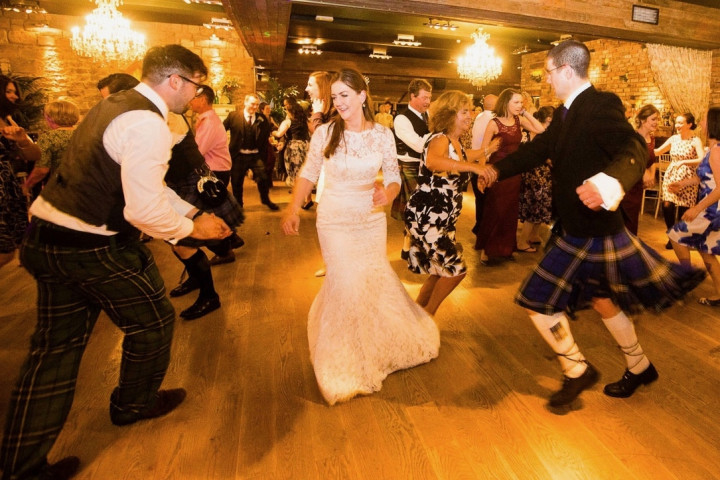
At most Scottish weddings, the question isn’t whether to have a ceilidh but how much of one. A short ceilidh set from your wedding band suits most couples. A full ceilidh night suits couples who want the whole evening built around it.
This guide covers the questions we’re asked most: which kind of band you need, how long the ceilidh should last, when it should start and which dances to choose.
What a wedding ceilidh actually is
A ceilidh (say “kay-lee”) is an evening of traditional Scottish dance music. The dances are group dances, done in couples, sets or long lines, so nobody is left standing alone on the floor.
The key person is the caller. Before each dance, the caller walks everyone through the steps, then talks them through it as the music plays. Nobody needs to know the dances beforehand. That’s why a ceilidh gets every age up, from the flower girls to the grannies.
Three ways to have a ceilidh at your wedding
1. A wedding band with a ceilidh section. This is the most popular choice. Most good Scottish wedding bands play a short ceilidh set as part of their normal night, alongside the pop, rock and soul. A Gay Gordons is about the best ice-breaker there is.
2. A band that does both equally well. A few bands are just as strong on a full ceilidh as on chart covers. They’re in high demand, so they tend to cost more and book up early.
3. A dedicated ceilidh band. If you want ceilidh for most of the night, book a specialist ceilidh band. Most play fiddle, accordion and drums, with a caller. Some can add a DJ set at the end, but not all do, so ask.
One thing to watch: if you want a longer ceilidh from a wedding band, check before you book. Some bands bring in an extra musician for an extended set, which can add to the fee.
How long should the ceilidh be?
With a wedding band, the ceilidh section usually runs for around 20 to 30 minutes, though some bands will happily play longer. That’s four or five dances, depending on how long the caller takes to teach each one.
It’s long enough for everyone to get stuck in, and short enough that the non-dancers don’t drift off to the bar. If ceilidh is the heart of your night, a dedicated ceilidh band will play the whole evening in sets.
When should it start?
There’s no fixed rule, but three slots are popular.
- Straight after the first dance. Guests are fresh, the room is full, and a couple of easy dances get both families mixing. It’s a brilliant way to start the night.
- After the buffet. If energy dips once the food appears, a Strip the Willow will wake the room up. Go easy, though. Spinning straight after a plate of stovies isn’t for everyone.
- Just before the break. End the first half with a bang. Even if people are a bit shy, having a short ceilidh set just before the break is a great way to warm them up for the second half. It also gives people a chance to cool down and recover if the ceilidh set gets a bit wild (which with any luck, it will).
Talk it through with your band. They’ll know what works best in your venue and with your timings.
Which dances to choose
The caller will usually pick dances to suit the crowd, but these are the favourites we see at weddings.
| Dance | How hard? | Why it works |
|---|---|---|
| Gay Gordons | Easy | Couples dance with simple steps; the classic opener |
| Canadian Barn Dance | Easy | Partners move round the room, so everyone mixes |
| Military Two-Step | Easy | Gentler pace, good for older guests |
| Dashing White Sergeant | Medium | Groups of six, great for mixing the two families |
| Strip the Willow | Medium | Long lines and lots of spinning; chaos in the best way |
| Eightsome Reel | Harder | Sets of eight; best with a few confident dancers in each set |
If there’s a dance you’d love, tell the band in advance.
Guests who’ve never been to a ceilidh
Don’t worry about them. Guests from England, overseas or anywhere else pick it up fast, because the caller teaches every dance. Some of the keenest dancers we see are guests trying it for the first time.
If you have a lot of first-timers, ask the caller to start with the easiest dances and build up from there.
Practical things to check
- Ceilidh dances need room, especially Strip the Willow. If the band sets up on the dance floor, there’s less of it. Our guide to choosing the right size band for your venue can help.
- Sound limiters. A room full of stamping feet can be louder than the band, and a strict limiter can cut the power mid-dance. Ask your venue if it has one, then read our guide to sound limiters.
- Let guests know a ceilidh is coming. A pair of flats in the bag saves a lot of sore feet.
- Ceilidh or barn dance? Both use a caller and group dances. A ceilidh uses Scottish and Irish tunes and dances; a barn dance comes from English and American folk traditions.
Quick answers
Do we need a caller for a wedding ceilidh?
Yes. The caller teaches each dance so everyone can join in. Dedicated ceilidh bands include one; with a wedding band, check who calls the dances.
How long should a wedding ceilidh last?
With a wedding band, around 20 to 30 minutes is typical. For a full ceilidh night, book a ceilidh band to play the whole evening.
What’s the best first ceilidh dance?
The Gay Gordons. It’s easy, it’s done in couples and it gets nearly everyone up.
Browse ceilidh bands in Scotland, or call Gaye or Lisa on 0141 413 4060 to find out which of our wedding bands play a cracking ceilidh set.